
About the Illustration
by Jackson Williams
The mark of any good writer is their ability to take you into a moment, scene, or feeling—Corey Hines’ poems did precisely that. As a Carolina boy who now lives in Georgia, I’ve spent much time along the Blue Ridge Mountains. Time moves differently there—slower—and in a country that values a fast-paced, electric lifestyle, it’s important to have work that reminds us of “those liminal, consequential days littering the sun.” Hines took me through familiar scenes of cattle farms and valleys embraced by kudzu and cicada-song. Nostalgia and a longing to return to these landscapes are why I chose his poems as my muse for the cover art contest.
2024-25 Honeycomb Literary Cover Art
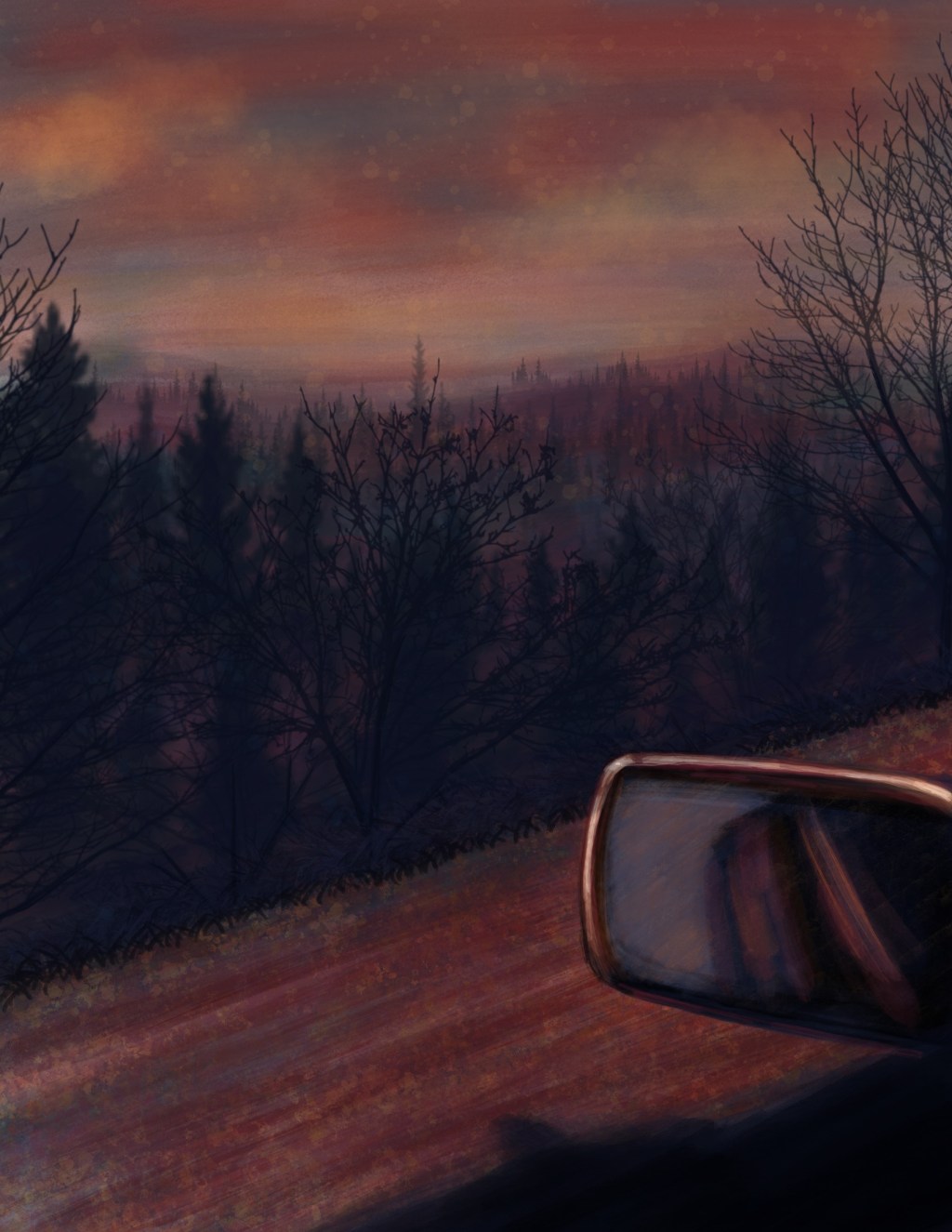
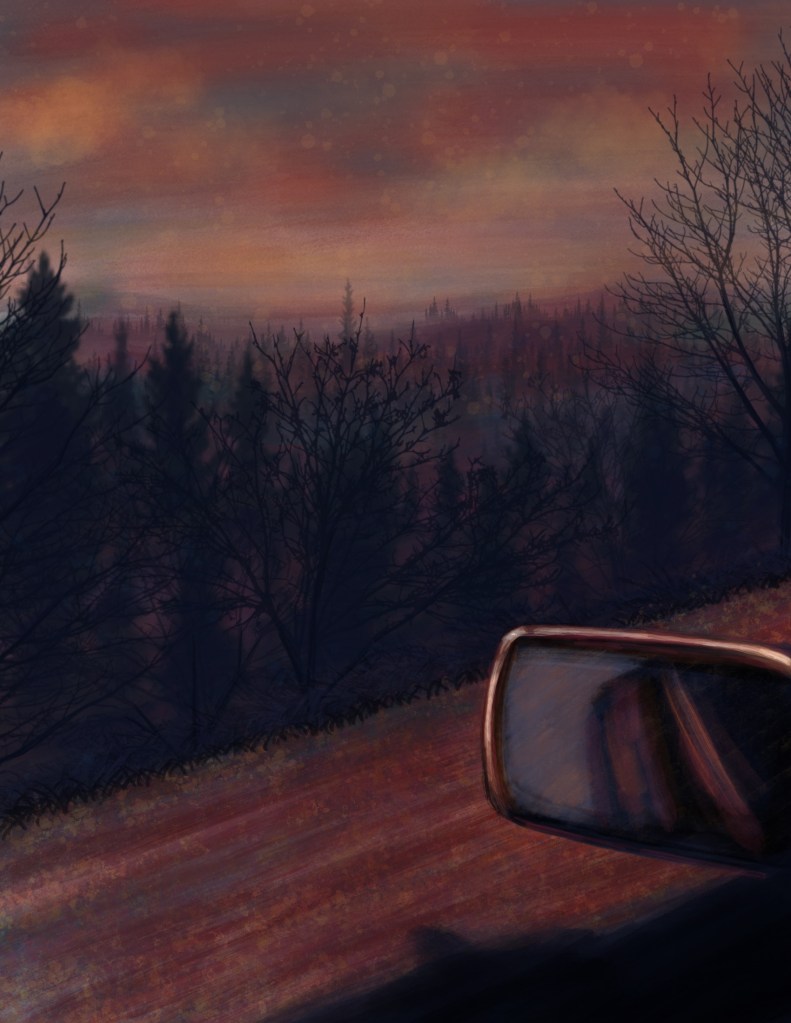
Sometimes, there’s nothing better for sorting your mind than taking a long drive on a lonely road. I chose a beat-up Appalachian road because they have this almost precarious quality—one wrong move, and you’re halfway down to meeting your maker. When I painted this scene, I knew I wanted to evoke a feeling of smallness by framing such a vast mountainscape within a car window. I think there’s poetry in that nearness to the edge, watching a beautiful view in the distance as the sun fades, knowing you’re one small part of it. It’s sobering.
Driving is a common motif in my own poetry because it allows me to play with feelings of control, leaving something behind or heading toward something else. A road represents our current trajectory. I was immediately intrigued by how Corey Hines handled these symbols in the following stanza:
“How many fragments of ourselves Litter a long dirt road?
That bends and forks endlessly?
A network of missed opportunities A network of what ifs?”
I painted a car mirror to reference the reflective qualities of his poem “Fragments of Ourselves,” which was the primary inspiration behind the cover artwork.
Regarding technique, I’ve been trained in traditional art for my entire life, and I wanted to mimic a painted style while using a digital program. To capture all of those sunset hues, I chose a complementary color palette of blue-violet and yellow-orange. Rather than going for realism, I opted for a brushy, somewhat impressionist style to emphasize emotion over practicality (isn’t that what poetry does best?). I wanted the viewer to be in the driver’s, or writer’s, point of view as they look out at the Appalachian sky.
Writing and art go hand-in-hand, so we have film, games, animation, and comics. Writers understand visuals because they must describe what they see, and artists must know how to incorporate symbolism and narrative into their work. I’ve always had a hand in both worlds, but my process for doing one or the other is pretty different. Writing takes my entire brain and soul, forcing me to confront and challenge myself in ways that aren’t always comfortable. Art, on the other hand, is easier for me to lose myself or do passively. I’m not sure why that’s the case—maybe it’s because I’ve pursued a career in the literary world, while art has been more of a lifelong hobby or side job. Both are equally intense!
Jackson Williams is a poet and SCAD Writing alum with a minor in Drawing. From a small town in South Carolina, his creative portfolio explores life and literature in the American South. When he’s not working, you can catch Jackson watching horror flicks, listening to Johnny Cash, or adventuring the outdoors.


 honeycomblit.org
Leave a comment