
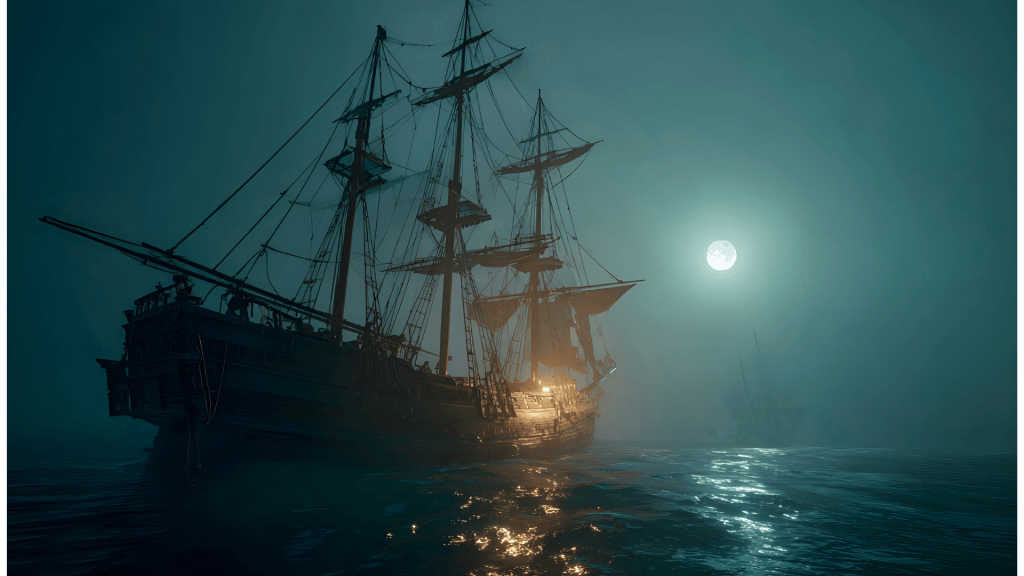
Some say sea monsters were just an imagination. Nothing more than tall tales from when people had veins full of ale, sitting around and trading lies. But monsters did once swim our seas, sink our ships, and seduce our sailors long ago. Humans, however, prey upon those who try to prey upon them, with the folly of this foe being more of a modern record.
It was after the Industrial Revolution that the seafolk began to see problems. As we constructed studier ships, casted stronger nets, and conducted streamlined slaying, the sea monsters’ claws lost their edge–their jaws lost their bite, and their siren songs lost their voice, all from the mechanical manifestations of man. They lusted for human blood but could no longer shed any. They refused to move past their desire to be humanity’s downfall, which in turn led to their own.
That event took place after a depraved monster attacked a ship in the North Atlantic Sea. The crew was full of fear as the beast held them dear, but they were not devoid of hope; they delivered an end to the monster most clear. Their harpoons penetrated the monster’s tail, back, and sides, coursing electricity through the creature from wires within. In a flash, the monster was fried.
The captain called for the corpse to be hauled onto the ship, desiring to take its teeth and claws to sell. The fishermen and their pulleys struggled to heave the beast onto the deck. Suddenly, the monster jolted awake, staring at the crew with yellow sclera, spidered with bloodshot veins. Before the men could rush to electrocute it once more, it garbled out a desperate watery plea to be spared.
“Please, have mercy on me, for I’m just so hungry,” it muttered as black blood oozed from its mouth and gills. “I hunt to bring back food for my own kind, just as you all do. Please, if I could just have a drop, just a taste of your blood, I’ll guide you to all the fish in the sea. Your men will never hunger again.”
Still readying their harpoons, none of the men thought to take the beast seriously, except the captain. The sea had been unforgiving to him; the haddock that used to be plentiful and profitable had become scarce. The seas were too competitive, and should he not do something soon, his nets were sure to become empty.
So, he pricked his finger on the tip of a harpoon. With the monster pinned down, he allowed a drop of his blood to grace the creature’s black tongue. It rose slightly, regaining just enough strength to grant the captain directions. Perhaps the captain should have assumed it to be a trick; the thought came to mind once the ship began to sway once more. The men laid siege upon the shapes in the water, and only after they depleted their weapons did the attack come to an end.
Some say the sea monster planned for his brethren to fight the fishermen–to sink the ship and feast upon the humans–but they were no match for human weaponry. Their traitor was allowed to live, however, for he had fulfilled his promise. The men indeed had a bountiful harvest, gutting and filleting the monsters as substitute seafood. The captain took the product to town, and soon every store begged for the privilege to sell the captain’s haddock on their shelves, regarding it as the best on the seven seas.
To maintain his wealth and success, the captain delivered more blood to the monster, and in turn, the monster delivered more lambs to the slaughter. Although the sea monster was originally caged and shackled in the holds, trust began to form between the human and the beast. As time went on, the monster began to enjoy the arrangement. It was being fed, much more than its brethren in the waters below, and thus it was grateful and loyal. Even when the captain requested more from the beast, for it to give up its teeth and its claws, it did so without much
hesitation at all. And once the beast no longer had any way of harming the fishermen, it was allowed to roam the ship as it pleased. The captain gave it clothes to hide its scales, necklaces to cover its gills, and ale to drink as any man deserves after a good day’s worth. It began to forget it was a monster at all. And as the days, weeks, and years passed by with each dip of the sun into the sea, the creature was no longer bothered by watching the men harpoon and gut its kind day after day. After all, the captain said it was a part of the crew now, one of his men. Men don’t concern themselves with the lives of monsters.
But a day came when the sea monsters were no more. Unable to reproduce faster than they were hunted, they were overfished. Once the captain realized this, he turned to his right-hand man and did what was necessary. It was an easy task, with the beast unable to fight back. Its fingers were bloodied from trying to scratch with claws that were no longer there. Its gums turned raw from trying to bite with teeth that were no more. The captain gutted and filleted the beast as he did with all the others. The beast lay on the floor, its clothing torn, its necklaces scattered, and the smell of ale drowned by the blood pooling in the beast’s toothless mouth. It was remarkable that such a horrendous creature could have ever thought it was human at all.

Kaliyah Powell is an undergraduate student concentrating in 2D Animation at SCAD Atlanta. Throughout her work, she aims to tell meaningful stories that have real impacts on those who experience them. She writes stories for both the young and old, utilizing the art of animation to enhance them in the way only animation can.



Leave a Reply